Unlocking the Power of Menthol Crystals: Properties, Applications & Benefits
Menthol crystals are widely recognized for their distinctive cooling sensation, refreshing aroma, and versatility across a broad range of industries. From personal care and cosmetics to oral care, topical formulations, and fragrance applications, menthol has become an important functional ingredient in many everyday products.
But what makes menthol crystals so valuable to formulators and manufacturers?
Beyond their familiar cooling effect, menthol crystals offer a combination of sensory, aromatic, and functional properties that make them useful across diverse formulations. Their characteristic freshness can enhance the consumer experience, while their crystalline form allows manufacturers to incorporate menthol into different product systems with appropriate formulation techniques.
In this article, we explore the properties, applications, benefits, quality considerations, and handling of menthol crystals.
What Are Menthol Crystals?
Menthol is a naturally occurring cyclic monoterpene alcohol commonly associated with mint oils, particularly peppermint and other Mentha species.
Menthol crystals are the purified crystalline form of menthol. They are typically characterized by their white to colorless crystalline appearance, strong mint-like aroma, and pronounced cooling sensation.
The cooling sensation associated with menthol is primarily linked to its interaction with sensory receptors in the skin and mucous membranes. This creates a perception of coolness without necessarily causing an actual reduction in the temperature of the surrounding tissue.
Menthol is available in different forms and grades depending on its source, purity, stereoisomeric composition, and intended application.
Key Properties of Menthol Crystals
Menthol crystals are valued because of their distinctive physical and sensory characteristics.
1. Cooling Sensation
The most recognizable characteristic of menthol is its intense cooling effect. When incorporated into suitable formulations, menthol can provide a refreshing sensory experience.
2. Distinctive Mint Aroma
Menthol has a characteristic fresh, minty fragrance that makes it useful in products where a clean and refreshing aromatic profile is desired.
3. Crystalline Form
The crystalline form provides manufacturers with a concentrated form of menthol that can be incorporated into formulations after appropriate dissolution or dispersion.
4. High Purity
High-purity menthol crystals are preferred for applications where consistent sensory performance, appearance, and formulation behavior are important.
5. Formulation Versatility
Menthol can be incorporated into a variety of products, including personal care products, oral care formulations, topical preparations, and fragrance applications, depending on the required grade and regulatory requirements.
How Does Menthol Create a Cooling Sensation?
One of the most interesting characteristics of menthol is that it can create a cooling sensation without actually making the skin significantly colder.
Menthol interacts with sensory receptors associated with the perception of cool temperatures, particularly the TRPM8 receptor. Activation of these receptors sends signals to the nervous system that are perceived as coolness.
This unique sensory mechanism is one of the reasons menthol is widely used in products designed to provide a refreshing or cooling experience.
It also explains why a relatively small amount of menthol can have a noticeable sensory impact in an appropriately designed formulation.
Major Applications of Menthol Crystals
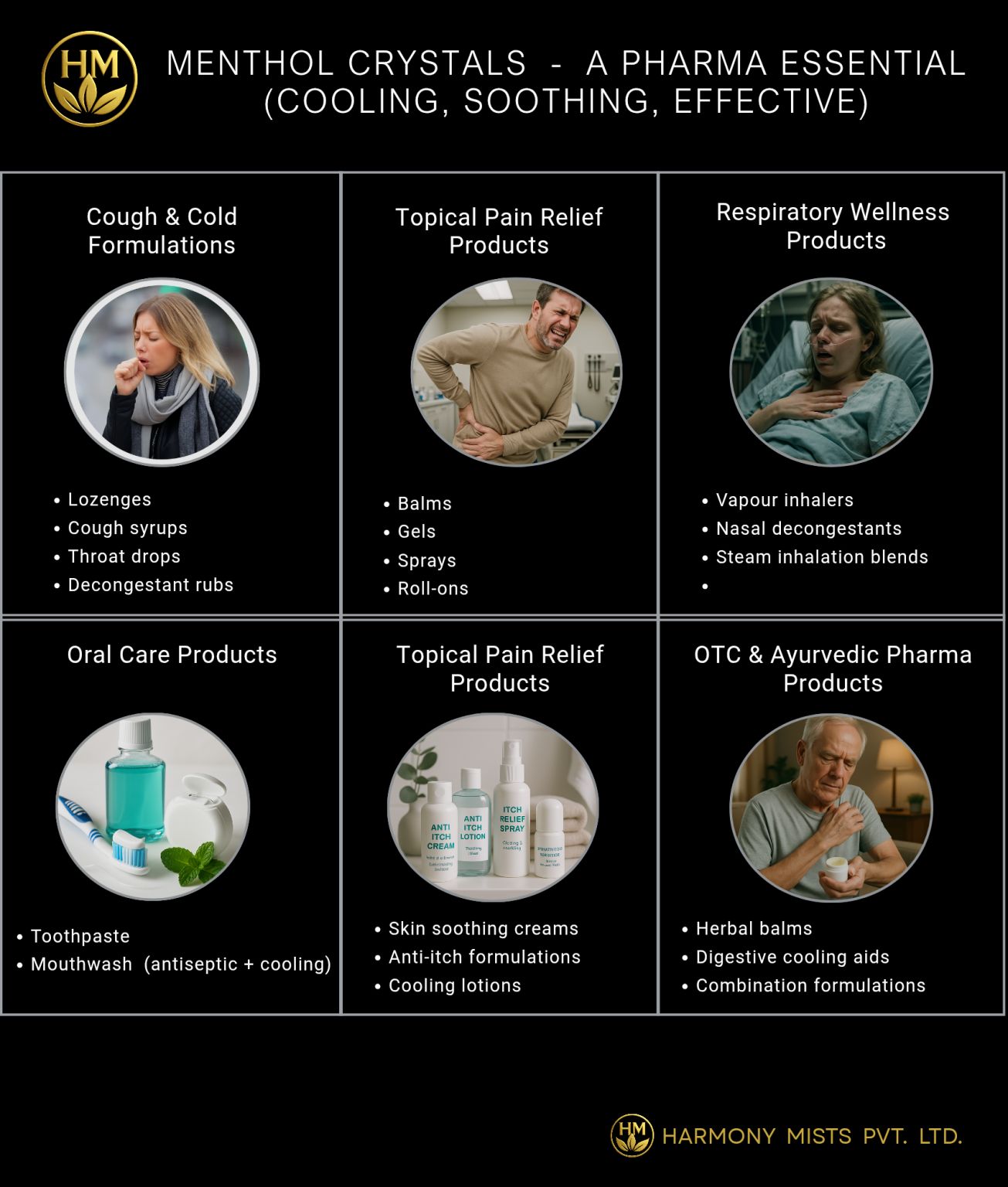
Menthol crystals have applications across several industries. Their exact use and permitted concentration depend on the formulation, product category, applicable regulations, and intended market.
Menthol Crystals in Cosmetics & Personal Care
Menthol is frequently used in personal care products where a cooling or refreshing sensory experience is desired.
Applications may include:
- Cooling gels
- Body care products
- Skin-care formulations
- Massage products
- Foot-care products
- Shaving and grooming products
- Refreshing creams and lotions
- Certain scalp and hair-care formulations
In these applications, menthol can contribute both sensory cooling and a characteristic mint fragrance.
Menthol Crystals in Oral Care
Menthol is widely associated with freshness in oral-care products.
It may be used in formulations such as:
- Toothpaste
- Mouthwash
- Oral rinses
- Breath-freshening products
- Oral-care concentrates
Its fresh mint profile can contribute to the perception of cleanliness and freshness.
Menthol Crystals in Topical Products
Menthol is also used in topical formulations where a cooling sensory effect is desired.
Examples can include:
- Balms
- Rubs
- Cooling creams
- Gels
- Massage formulations
- Topical preparations
For pharmaceutical or medicinal products, the applicable regulatory requirements and permitted uses should always be considered when developing a formulation.
Menthol Crystals in Fragrance & Aroma Applications
The characteristic minty aroma of menthol makes it useful in selected fragrance and aroma formulations.
It can contribute:
- Freshness
- Mint character
- Cooling sensory perception
- Aromatic top notes
Menthol may also be combined with other aroma ingredients to create specific sensory profiles.
Menthol Crystals in Hair & Scalp Care
Menthol is used in some hair and scalp products to provide a refreshing sensory experience.
It can be found in selected:
- Shampoos
- Scalp treatments
- Hair tonics
- Cooling scalp products
The sensory effect can make products feel particularly refreshing when applied to the scalp.
Why Are Menthol Crystals Valuable in Formulations?
The popularity of menthol comes from its ability to combine several desirable characteristics in one ingredient.
Sensory Enhancement
Menthol can provide an immediate perception of freshness and cooling, helping manufacturers create a distinctive user experience.
Aromatic Contribution
Its characteristic mint profile can contribute to the fragrance identity of a formulation.
Formulation Flexibility
Menthol can be incorporated into different product formats when suitable formulation techniques and compatible ingredients are used.
Strong Sensory Impact
Because menthol produces a noticeable cooling sensation, relatively controlled quantities can have a significant effect on the sensory character of a product.
Menthol Crystals vs. Menthol Oil
Menthol crystals and mint essential oils are related but are not interchangeable ingredients.
Menthol crystals are a concentrated crystalline form of menthol and are generally selected when a formulation requires the specific properties of menthol itself.
Mint essential oils, such as peppermint oil, contain a complex mixture of naturally occurring compounds. Their composition can vary depending on botanical source, cultivation conditions, extraction method, and processing.
The choice between menthol crystals and mint oil therefore depends on the formulation objective.
If a manufacturer requires a defined menthol ingredient with a strong cooling effect, menthol crystals may be more appropriate. If the objective is to create a broader natural mint aromatic profile, an essential oil may be considered.
Important Quality Parameters for Menthol Crystals
For industrial buyers and formulators, quality consistency is an important consideration.
Depending on the intended application, typical quality parameters may include:
- Appearance
- Odour
- Assay / purity
- Optical rotation
- Melting point
- Identification
- Residual solvents, where applicable
- Moisture
- Related substances
- Packaging
- Batch consistency
The appropriate specification should always be established according to the intended application and relevant regulatory or customer requirements.
A Certificate of Analysis (COA) should be reviewed for each batch to confirm that the supplied material meets the agreed specification.
Storage and Handling of Menthol Crystals
Menthol crystals should be handled and stored according to the supplier's technical documentation and applicable safety requirements.
Good storage practices generally include:
- Keep the material in a tightly closed container.
- Store in a cool, dry and well-ventilated area.
- Protect from excessive heat.
- Avoid unnecessary exposure to moisture.
- Keep away from incompatible materials.
- Follow the relevant Safety Data Sheet (SDS/MSDS) for handling and storage instructions.
Because menthol is strongly aromatic, appropriate packaging can also help minimize loss of aroma and contamination during storage.
How to Choose a Reliable Menthol Crystals Supplier
For manufacturers purchasing menthol crystals in commercial quantities, price should not be the only consideration.
Important factors include:
Consistent Quality
A reliable supplier should be able to provide consistent material quality from batch to batch.
Technical Documentation
Depending on the application and market, buyers may require documents such as:
- Certificate of Analysis
- Safety Data Sheet
- Product Specification
- Technical Data Sheet
- Origin documentation
- Regulatory or compliance documentation, where applicable
Packaging Options
The packaging should be appropriate for the product, transportation conditions, storage requirements, and customer's handling process.
Supply Reliability
For industrial manufacturing, continuity of supply can be just as important as the initial product price. A supplier should have dependable sourcing and logistics capabilities.
Application Understanding
A supplier with knowledge of the end-use application can help buyers select the appropriate grade and documentation for their requirements.
Menthol Crystals for Global B2B Supply
For international buyers, sourcing menthol crystals from an experienced ingredient supplier can simplify procurement and improve supply consistency.
At Harmony Mists, we focus on supplying ingredients for a range of industrial applications, supporting customers with product information, specifications, documentation, and export-oriented supply requirements.
Our approach is centered on providing consistent quality, dependable communication, appropriate documentation, and practical support for B2B buyers.
For customers evaluating menthol crystals for cosmetics, personal care, oral care, fragrance, or other suitable applications, product specifications and requirements can be discussed based on the intended application and destination market.
Conclusion
Menthol crystals are much more than a source of minty fragrance. Their distinctive interaction with sensory receptors, characteristic aroma, crystalline form, and strong cooling perception make them valuable ingredients for a wide variety of formulations.
From personal care and oral care to topical products and fragrance applications, menthol continues to offer formulators an effective way to introduce freshness and a distinctive sensory experience.
For manufacturers and ingredient buyers, however, successful use of menthol begins with selecting the right quality, specification, documentation, packaging, and supply partner.
As demand for sensory-driven personal care and functional ingredients continues to evolve, menthol crystals remain an important ingredient for formulators looking to create products with a recognizable and refreshing user experience.
Frequently Asked Questions
What are menthol crystals?
Menthol crystals are the purified crystalline form of menthol, a naturally occurring compound commonly associated with mint oils. They are known for their characteristic mint aroma and cooling sensory effect.
What are menthol crystals used for?
Menthol crystals are used in various applications including cosmetics, personal care, oral care, topical formulations, hair and scalp products, fragrance, and other suitable industrial formulations.
Why do menthol crystals feel cold?
Menthol activates sensory receptors associated with the perception of cool temperatures, particularly TRPM8 receptors. This produces a sensation of cooling without necessarily causing an equivalent physical decrease in temperature.
Are menthol crystals natural?
Menthol can be obtained from natural mint-derived sources or produced through other manufacturing processes. Buyers should check the product's source and supplier documentation when natural origin is an important requirement.
Are menthol crystals soluble in water?
Menthol has limited solubility in water and is more readily soluble in certain organic solvents and suitable formulation media. Formulators should evaluate the appropriate solvent system and processing method for their specific product.
How should menthol crystals be stored?
Menthol crystals should generally be kept tightly closed in a cool, dry and well-ventilated area and protected from excessive heat and moisture. Always follow the supplier's SDS/MSDS and storage recommendations.
What documents should be requested when purchasing menthol crystals?
Depending on the application and destination market, buyers may request a Certificate of Analysis, Safety Data Sheet, product specification, technical data sheet, origin documentation, and other applicable compliance documents.
How can I source menthol crystals in bulk?
Industrial buyers can contact an experienced ingredient supplier with their required grade, quantity, packaging, application, and destination details. The supplier can then provide the relevant specification, documentation, quotation, and logistics options.